Featured Commercial & Specialized OEM Fleet Carts
Explore our precision-engineered OEM cart platforms designed for hotel operations, commercial catering, mobile food service, medical facilities, and high-capacity logistics.

HONLU Mobile Bar Commercial Food Truck & Coffee Shop Cart
Heavy-duty commercial food trailer featuring a full stainless-steel kitchen layout, hydraulic brake axle system, and street-legal compliance safety fittings.

Commercial Hotel Room Service Janitorial & Housekeeping Trolley
High-capacity hospitality room service trolley built with impact-resistant polypropylene, multi-layer shelf dividers, and heavy-duty refuse collection bags.

Commercial 33L Housekeeping Cart with Adjustable Handle
All-weather indoor/outdoor utility cart featuring ergonomic adjustable handles, 4 heavy-load caster wheels, and UV-stabilized polymer chassis.

Moto Piaggio Ape Custom Coffee & Catering Engine Cart
Iconic 3-wheeler motorized mobile retail platform customized with complete espresso bar fixtures, refrigeration enclosures, and self-contained water tanks.

2-Tier Stainless Steel Commercial Kitchen Service Cart
Heavy-gauge movable service trolley engineered with dual deep-well trays, anti-spill retaining borders, and noise-damping wheel assemblies.

3-Layer Medical & Dental Equipment Mobile Utility Stand
Precision medical mobile cart constructed with powder-coated steel, integrated power outlet socket strip, smooth drawers, and lockable caster wheels.

Commercial Catering Heavy-Duty Round Tube Trolley Cart
Industrial food service cart designed with seamless 201/304 stainless steel tubing, high-payload structural bracing, and corner anti-collision guards.
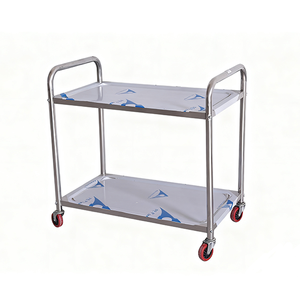
Custom Two-Layer Eco-Friendly Stainless Steel Hand Push Cart
Tailor-made kitchen serving cart featuring customized dimensions, sound-damped stainless steel shelves, and smooth ergonomic pushing handles.
Engineering Next-Generation Commercial Fleet & Utility Cart Platforms
An executive overview of procurement strategies, material engineering standards, total cost of ownership (TCO) optimization, and custom OEM manufacturing workflows.
In modern industrial procurement, selecting a Custom OEM Fleet Cart Manufacturer & Supplier goes far beyond simple equipment sourcing. Enterprise buyers across hospitality, healthcare, commercial catering, and urban last-mile logistics demand customized fleet carts that deliver mechanical reliability, strict compliance with safety directives (such as DOT, CE, and NSF), and optimized lifecycle economy.
As global supply chains transition toward sustainable electric mobility and modular equipment architecture, our manufacturing enterprise has pioneered standard-setting manufacturing methods. By unifying robotic chassis welding, high-precision metal stamping, and specialized polymer formulation, we furnish global fleet operators with custom-tailored mobile units engineered for multi-shift operational longevity.
1. The Shift to Smart Modular Chassis Engineering
Traditional single-body cart designs often force operations managers into operational trade-offs. Modern commercial fleets require modularity: a core frame capable of receiving interchangeable modules—ranging from food service thermal boxes and janitorial supply racks to heavy-duty motorized battery trays and medical equipment towers.
Our OEM engineering platform uses Finite Element Analysis (FEA) to stress-test high-tensile steel and 304/316 stainless steel frame structures. This guarantees structural stability under continuous max-payload operation (up to 800 kg static capacity), preventing frame deflection and reducing long-term wheel caster alignment degradation.
Modular Chassis Integration
Standardized mounting points allow fast field upgrades from manual push configurations to motorized drive platforms, reducing capital re-investment cycles.
Lithium LiFePO4 Integration
Equipped with automotive-grade Smart BMS modules, our electric utility and food carts offer 3,500+ charge cycles and zero maintenance overhead.
Anti-Corrosion Metallography
Submerged e-coating combined with 200°C powder baking yields 1,200-hour salt spray resistance (ASTM B117 standard) for harsh resort or outdoor environments.
2. Total Cost of Ownership (TCO) Optimization for Fleet Procurement
When evaluating custom OEM cart manufacturers, procurement teams must analyze TCO over a 5-to-10-year operating horizon rather than focusing solely on upfront piece-part price. Inexpensive off-the-shelf utility carts frequently exhibit premature wheel-bearing failure, caster bracket tearing, and surface oxidation within 12–18 months of intensive hospital or hotel service.
Our OEM manufacturing process embeds lifecycle value directly into the hardware architecture:
- Maintenance-Free Caster Hubs: Sealed double-ball-bearing polyurethane wheels prevent fiber entanglement and eliminate lubrication requirements.
- Impact-Absorbing Molded Polypropylene: Chemical-resistant, virgin PP polymers absorb structural shocks without cracking, protecting resort facility walls and elevator frames.
- Ergonomic Push Force Dynamics: Precision-calculated center-of-gravity placement reduces initial manual push forces below 15 kg for heavy loads, mitigating workplace compensation claims.
Future Trends in Commercial & Industrial Fleet Carts
Key structural shifts reshaping global enterprise cart manufacturing, material science, and fleet automation over the next decade.
1. IoT Telematics & Smart Fleet Management
Future commercial mobile carts will incorporate embedded IoT sensor arrays. Fleet supervisors will track real-time cart location, payload weight thresholds, door lock states, and predictive maintenance metrics via cloud telemetry dashboards.
2. Antimicrobial & Easy-Clean Polymer Surfaces
In medical and hospitality environments, non-porous antimicrobial polymer additives are becoming mandatory. These additives active at the molecular level disrupt bacterial cell walls, lowering cross-contamination risks across multi-shift housekeeping operations.
3. Standardized Hot-Swappable Battery Eco-Systems
Motorized mobile catering and room service units are abandoning fixed battery installations in favor of standardized, hot-swappable lithium power packs. This enables 24/7 continuous operations without vehicle downtime during recharge cycles.
Enterprise Customization Capability Overview
Compare our engineered cart platforms, material configurations, load tolerances, and international compliance standards.
| Fleet Platform Category | Primary Material Build | Max Load Payload | Mobility / Power Options | Compliance & Certifications |
|---|---|---|---|---|
| Mobile Food & Beverage Trailers | Food-Grade 304 Stainless Steel & Galvanized Chassis | 1,200 kg – 2,500 kg | Motorized Towing / Engine Drive / Electric LSV | DOT, CE, NSF/ANSI Standard 2 |
| Hotel Housekeeping Carts | High-Density UV-Stabilized Polypropylene (PP) | 250 kg – 450 kg | Manual Ergonomic Push / Power-Assist Caster | ISO 9001:2015, REACH Polymer Compliance |
| Kitchen & Dining Service Trolleys | Seamless 201/304 Stainless Tubing & Deep Trays | 150 kg – 300 kg | 360° Silent Medical-Grade TPR Casters | FDA Food Contact Safe, CE Sanitation |
| Medical & Salon Equipment Stands | Electrostatic Powder-Coated Steel & ABS Drawers | 100 kg – 200 kg | Integrated Power Strips & Lockable Wheels | IEC 60601 Electrical Safety, CE Medical |
| Motorized Vintage Catering Carts | Custom Fiberglass Body & Reinforced Engine Frame | 600 kg – 1,000 kg | Gasoline Engine / Electric Lithium Drive Train | EEC/COC Street Legal, DOT Standards |
World-Class OEM/ODM Manufacturing Superiority
Leveraging advanced robotics, rigorous quality assurance, and end-to-end global logistical support.
Precision Robotic Fabrication
Our automated fiber laser cutting cells and multi-axis welding robots maintain tolerances within ±0.1mm, ensuring perfect component interchangeability across thousand-unit fleet runs.
Strict Quality Control Protocol
Every single OEM cart undergoes rigorous testing prior to container loading: 150% static load stress tests, continuous caster rotation audits, thermal insulation checks, and salt-spray corrosion validation.
Full Customization & Rapid Tooling
From custom powder-coat RAL color matching and laser-etched corporate logos to complete 3D CAD prototype development within 10 business days, we accelerate your brand's time-to-market.
Frequently Asked Questions (FAQ)
Expert insights on customization options, ordering processes, shipping logistics, and compliance standards for commercial fleet purchases.
1. What safety and legal certifications apply to motorized food trucks and commercial electric utility carts?
For motorized food trucks, mobile bar carts, and low-speed electric vehicles (LSVs) intended for public road or commercial facility use, compliance varies by jurisdiction. In North America, vehicles typically require DOT (Department of Transportation) compliance, NHTSA-registered VINs, and safety glass windshields. In Europe, CE marking and EEC/COC (Certificate of Conformity) certifications are necessary for street registration. Commercial kitchen components must also adhere to NSF/ANSI Standard 2 for food sanitation safety.
2. What are the Minimum Order Quantities (MOQ) and lead times for custom OEM fleet orders?
For standard catalog models (such as 2-tier stainless catering trolleys or 33L polypropylene janitorial carts), our sample MOQ starts at 1 to 5 units. For bespoke OEM/ODM custom developments—which involve custom frame stamping, specialized polymer injection molds, or tailored electrical harnesses—our standard production MOQ ranges from 10 to 50 units depending on complexity. Prototypes are typically completed in 10-14 days, followed by mass production cycles of 25-35 days.
3. How do 201, 304, and 316 stainless steel grades differ in catering and housekeeping cart construction?
Grade 201: Cost-effective stainless steel suitable for dry indoor utility environments with low humidity exposure.
Grade 304: The industry standard for commercial kitchens, healthcare, and food service. Offers superior corrosion resistance against water, food acids, and cleaning chemicals.
Grade 316: High-grade marine-level stainless steel containing molybdenum, specified for coastal resorts, outdoor seafood service, and sterile hospital rooms exposed to harsh saline or chlorine environments.
4. Can our fleet carts be pre-configured with custom brand wraps, power sockets, and GPS telematics?
Yes. As a direct OEM manufacturer, we integrate factory-installed customization options during assembly. Options include precision vinyl branding wraps, silk-screened logos, integrated multi-region AC power outlets (110V-240V), smart USB ports, solar roof panels, integrated lockboxes, and OBD-II cloud GPS tracking devices tailored to your management platform.
5. What warranties and spare parts support structures do you offer international enterprise buyers?
We support all OEM fleet products with a comprehensive factory warranty: 3 to 5 years on structural frames and chassis welding, 2 years on electric motors and lithium battery packs, and 1 year on wear-and-tear components like casters and soft bags. We also maintain a rapid-ship spare parts inventory, delivering replacement casters, controllers, hinges, and electronic modules via express air freight worldwide within 72 hours.
6. How does lithium battery integration lower total cost of ownership compared to traditional lead-acid carts?
Lithium Iron Phosphate (LiFePO4) battery packs offer significant performance and financial advantages over lead-acid alternatives. They eliminate weekly water topping, terminal corrosion cleaning, and acid leak risks. Lithium packs weigh up to 60% less, reducing tire wear and motor strain, while providing 3,500+ charge cycles compared to just 500-800 for lead-acid banks. This translates to lower energy costs, zero battery maintenance downtime, and extended operational lifespans for enterprise fleets.
Ready to Upgrade Your Commercial Fleet Operations?
Partner with a trusted factory-direct OEM/ODM manufacturer. Contact our engineering team today to request custom CAD drawings, wholesale pricing matrices, or sample units.